In this guide
How to Evaluate AI Researchers Beyond Citation Counts
· ForesIQ
Evaluate AI researchers through relevant work, individual contribution and research context. Citation counts can prompt useful questions, but they do not establish fit for a role. Pair the record with a structured discussion of the problem, the researcher’s decisions, the evidence and what they would investigate next.
A research lead receives two promising profiles. One has a long, highly cited record in a broad field. The other has a shorter record closely connected to the team’s current problem. Which person should move forward?
A total citation count cannot answer that question. The team needs to understand what each person has contributed, how it relates to the brief and which uncertainties require a conversation. This guide gives recruiters and research leaders a practical framework for that review. Use it to decide what to review and what to ask next, with technical assessors examining the research itself.
What do citation counts tell you about an AI researcher?
A citation count records references to work within a particular collection of publications. It can help identify work that has attracted attention and give a reviewer places to investigate its influence. It does not explain why a paper was cited, which author made which contribution or whether that contribution fits your team’s problem.
Time also matters: an older paper has had longer to accumulate references. Publication and citation practices differ between research communities. Before comparing totals, ask whether the people work in comparable areas, whether their records span similar periods and what the cited work actually contributed.
The San Francisco Declaration on Research Assessment, or DORA, calls for evaluating the substance of research rather than using journal-level metrics as a proxy for an individual’s contribution. Our recommendation for recruiting is to apply the same discipline to convenient headline numbers: use them to guide investigation, then examine the relevant work.
A highly cited paper can be worth reading without settling a hiring decision. A recent paper with little accumulated attention can also be relevant. Neither observation establishes how its author will perform in your organisation.
A practical framework for screening AI research scientists
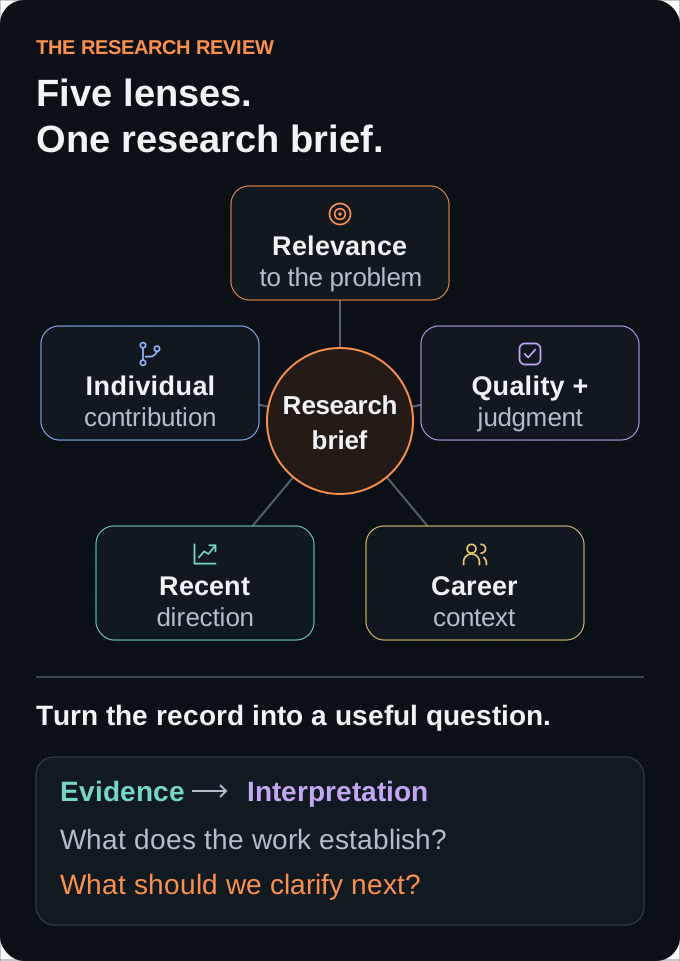
Agree on the research brief before comparing people. Then examine five dimensions. Keep the findings separate rather than collapsing them into a single homemade score whose meaning the team has not agreed on.
1. Relevance to the research problem
Name the problem the team needs to solve and identify work that bears on it. Look beyond shared keywords: compare the task, assumptions, methods and evaluation setting. “World models,” for example, is too broad a phrase to establish that two researchers are tackling the same problem.
Record the connection in one sentence. If you cannot explain it without relying on a famous employer or venue, the case for relevance needs more work. For help defining the search itself, use our AI research scientist sourcing guide.
2. Individual contribution
Large collaborations produce shared outputs. Establish which parts the person owned: framing the question, developing a method, building experiments, analysing results or leading other contributors. Author position alone should not carry the whole interpretation.
The CRediT contributor taxonomy describes research contributions through roles such as methodology, software, validation and supervision. Those distinctions offer useful vocabulary for an interview. Do not assume a paper uses CRediT or that an unstated role belongs to a particular author.
3. Research quality and judgment
Ask a technical reviewer to examine the claim and the evidence supporting it. Which baselines were appropriate? What assumptions were necessary? What did the experiments fail to establish? Where would the method stop working?
For the recruiter, the handoff can be simple: identify the relevant work and the questions it raises. The research assessor should evaluate the scientific reasoning. A candidate’s explanation can then clarify decisions that are not visible in the paper.
4. Trajectory and recent direction
Read the sequence of work. Is the researcher developing a sustained programme, moving into an adjacent area or repeatedly testing a particular idea? The most recent contribution may reveal a direction that a short biography has not caught up with.
Keep research activity distinct from research standing. Someone may have an established body of influential work and a quieter recent publication record. Another person may be publishing frequently while a new direction is still developing. Explore the context before drawing conclusions.
5. Career context and evidence gaps
Check affiliations, dates and education where supported. Treat the earliest publication you can establish as a fact about the visible record, not a complete measure of experience. Missing or dated public information may require a direct clarification.
Separate location from availability. An employer’s country does not tell you whether someone can or wants to join your team. Practical constraints and research interests should be discussed explicitly, not inferred from a profile.
Turn research signals into better screening questions
Use this table during a first review. The “limitation” column keeps each signal connected to what it actually establishes.
| Signal | Possible interpretation | Limitation | Follow-up question |
|---|---|---|---|
| Repeated work on a relevant problem | A sustained research direction. | Topic overlap does not establish individual ownership. | Which decisions and contributions were yours? |
| Highly cited work | A contribution worth investigating for influence. | The total does not explain the reason for attention or fit to this role. | What did later researchers adopt, test or challenge? |
| Recent movement into a new topic | An emerging specialism or adjacent capability. | The direction may still be exploratory. | What connects this work to your earlier research? |
| Publication at a relevant conference | A useful entry point into a research community. | The venue does not replace reading the work. | What was the contribution, and where was it evaluated? |
| A large collaborative paper | Experience contributing within a research team. | Co-authorship leaves responsibilities unclear. | What did you own, and how did your work connect to others? |
| A gap in the publication record | A point where more context is needed. | Publications do not capture every research activity. | Which work or responsibilities are missing from this record? |
Worked example: two researchers, two kinds of relevance
The profiles and research brief below are fictional. They illustrate a review process, not a ranking of real people.
A team wants to investigate manipulation policies that generalise to unfamiliar objects. It is considering two researchers:
- Researcher A has an established record in visual representation learning. Their work has attracted substantial attention, and a recent project explores an embodied setting. Their potential value is a deep foundation with an adjacent connection to the brief.
- Researcher B has a shorter publication record focused on learning manipulation policies. Recent work addresses unfamiliar objects in a setting similar to the team’s. Their apparent connection is direct, while their independent contribution still needs examination.
A citation-first sort might put A first. A keyword-only search might put B first. Neither establishes the right choice. Ask the research lead whether the role most needs foundational representation expertise, direct manipulation experience or a combination the current team lacks.
The next step could be a different technical discussion for each person. Ask A what transfers from the representation work and what breaks in the new setting. Ask B which parts of the manipulation work they owned, how the evaluation was designed and which limitations remain. Compare the answers against the same role requirements.
A useful evaluation produces a rationale and a next question. “Relevant to unfamiliar-object manipulation; individual ownership needs clarification” gives a team more to act on than “impressive profile.”
Questions to ask in an AI research scientist interview
Invite the researcher to choose a relevant contribution they can discuss openly. Give them the role’s research brief beforehand. Keep confidential work out of the request and ask the technical interviewer to adapt the depth to the role.
- What was the research question? Ask what earlier approaches could not explain or achieve.
- What did you personally contribute? Ask how responsibilities were divided and which decisions they owned.
- Which alternative did you reject? Explore the trade-off and the evidence behind it.
- What would weaken your conclusion? Discuss assumptions, evaluation limits and potential counterexamples.
- What did an unsuccessful experiment teach you? Ask how it changed the next investigation.
- How would you approach our problem? Look for a reasoned research plan and explicit uncertainty, not a promise of a result.
Use a consistent set of core questions across candidates while allowing subject-specific follow-ups. Record evidence against the agreed requirements. A confident presentation alone should not settle whether the research reasoning is sound.
A research candidate review template your team can reuse
For each dimension, record the evidence, what it supports, what remains unknown and who will resolve it. Use the template to make the next team discussion specific and evidence-led.
Research problem: [the role’s specific brief]
Relevant contribution: [work and link]
Individual role: [supported account; unknown if not established]
Technical review: [claim, evidence, assumptions and limitations]
Current direction: [recent work and interests to clarify]
Career context: [supported details and dates]
Unresolved questions: [what needs checking]
Recommendation: [next action, rationale and reviewer]
Write down disagreements rather than hiding them inside an average rating. If one reviewer sees direct relevance and another sees a weak experimental match, that disagreement identifies the next useful conversation.
Frequently asked questions
How many citations should an AI research scientist have?
There is no single threshold that establishes suitability for every role. Start with the relevant work, its context and the person’s contribution. A team can define role-specific evidence requirements without treating a citation total as an automatic pass or rejection.
Can you compare researchers across different AI fields?
You can compare their relevance to the same role, but raw publication and citation totals need context. Begin with the research problem and interpret each record within its area. In ForesIQ, scores describe standing within a research area rather than a universal ranking across fields.
How should you evaluate an early-career researcher?
Examine the contribution they can demonstrate, the reasoning behind it and the questions they are developing. Give a shorter record its proper context. Avoid treating the absence of a long publication history as proof that the relevant capability is absent.
Does publication at a leading conference prove a researcher is right for the role?
No. It provides a useful piece of context and work to review. You still need to establish its relevance, the individual contribution and the research judgment required by the role.
Should a research score decide whom to hire?
No. A score can help organise discovery and frame questions, but the team must examine the supporting work and assess the role’s requirements. Research standing, research interests and suitability for a particular team are different questions.
See the researcher in context
ForesIQ brings research expertise, supported career evidence and field-relative labels into a shared talent intelligence workspace. The ForesIQ Score describes standing within an area; Momentum and Activity offer complementary views of trajectory and output. They support investigation rather than deciding who should join a team.
Explore how to interpret ForesIQ’s scoring and labels, or open an illustrative researcher profile to see the information together. Request A Demo and we’ll send you a personalised demonstration of how ForesIQ brings researcher expertise and research context together.