In this guide
How to Find AI Research Scientists: A Sourcing Guide
· ForesIQ
To find AI research scientists, start with the research problem. Translate the role into specific topics, find relevant work, identify the people behind it, verify their current context and build an evidence-backed shortlist. Job titles and employer names help you navigate; the work explains the match.
A request to “find a strong AI researcher” leaves a recruiting team with too many plausible people and too little basis for choosing between them. A researcher advancing robot manipulation, a language-model evaluation specialist and a scientist working on distributed training may all fit the title. They do not fit the same brief.
This guide is for talent teams, founders and research leaders building frontier technology teams. It offers a practical sourcing workflow, an illustrative robotics search and templates you can reuse. The goal is to reach people whose work connects to the problem your team needs to solve.
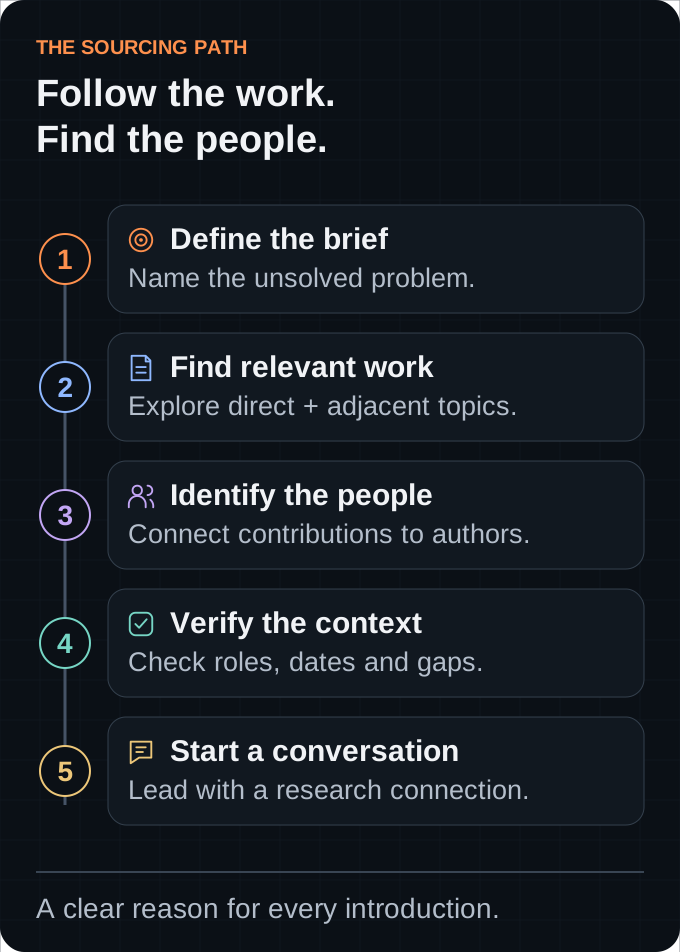
1. Turn the job description into a research brief
Start with a conversation with the person accountable for the research. Ask what remains unsolved, what the new colleague would own and what evidence would make a profile worth discussing. Separate the scientific question from the technologies used around it.
“Experience with Python and deep learning” describes a broad toolkit. “Develop policies that transfer from demonstrations to reliable manipulation of unfamiliar objects” gives you a research direction. The second formulation makes it easier to recognise relevant contributions under different job titles.
Use this brief before searching:
- Problem: What question or limitation will the researcher work on?
- Research topics: Which methods or subject areas are directly relevant?
- Evidence: What kind of contribution should the team be able to examine?
- Adjacent expertise: Which nearby specialisms could transfer?
- Practical constraints: What location, collaboration, start-date or role constraints actually matter?
- Open questions: Which requirements are preferences rather than necessities?
Clarify the role’s centre of gravity, too. For a research scientist, you might prioritise formulating questions and developing methods. For a research engineer, you might prioritise building the systems and experiments that make research possible. Titles vary between organisations; agree on the expected contribution instead of treating either title as a universal definition.
2. Find relevant work, then identify the people behind it
Use a combination of publication records, research-group pages, professional profiles and specialist Research Talent Intelligence. Each helps answer a different question. No single page should carry the whole decision.
| Starting point | Useful for | Check before relying on it |
|---|---|---|
| Conference proceedings | Finding work on a defined topic and its authors. | The actual contribution, publication year and relevant track. |
| Research-group and personal pages | Understanding a person’s stated interests and career context. | When the page was updated and whether the affiliation is current. |
| Professional profiles | Connecting research history with a professional identity. | Whether a title or summary captures the specialism you need. |
| Collaboration networks | Finding adjacent researchers through connected work. | Each individual’s contribution; co-authorship alone does not establish it. |
| Research Talent Intelligence | Exploring expertise, standing and career context together. | Field coverage, dates, evidence gaps and what labels mean. |
For practical starting points, the NeurIPS proceedings archive organises published research by year. The ACL Anthology provides access to computational linguistics and natural language processing literature. The RSS 2025 accepted-paper list connects robotics paper titles with authors and session topics. These public resources are starting points. Each covers a particular part of the research landscape, so choose the ones that fit your brief.
Search the topic using several related formulations. Read enough of a promising paper to establish the problem, proposed contribution and evaluation setting. Then follow the people connected to relevant work. A familiar venue can help orient the search, but a publication there is not an automatic match for your role.
Keep direct and adjacent candidates distinguishable. Someone studying general visual representations may offer useful foundations for robot learning, while someone studying manipulation policies may have a closer demonstrated connection. Both can deserve a conversation for different reasons.
3. Worked example: source a robot-learning researcher
This is an illustrative search, not a customer case study. The profiles below are fictional.
Imagine a team developing manipulation systems for unfamiliar objects. Its initial request is “a senior AI scientist.” After discussing the work, the team defines a more useful brief: investigate learning approaches that improve manipulation beyond the objects and demonstrations seen during training.
Search direction: robot learning, dexterous manipulation, imitation learning and generalisation. Treat visual representations and simulation transfer as adjacent routes to explore. Ask the research lead which evidence would demonstrate relevance to the team’s hardware and operating conditions.
Now compare three possible routes into the search:
- Profile A: repeated work on learning manipulation policies, including evaluation with unfamiliar objects. The apparent connection is direct; the next question is what the researcher personally contributed.
- Profile B: a substantial record in visual representations with a recent move towards embodied settings. The connection is adjacent; the research lead should assess which capabilities could transfer.
- Profile C: a prominent general machine-learning record without visible work on the relevant manipulation problem. Keep the reputation separate from the evidence of fit.
This comparison does not establish who is “best.” It tells the team why each person is in the conversation and what would resolve the uncertainty. If the search yields only adjacent profiles, revisit the brief before expanding the list indiscriminately.
You can explore a similar way of turning a technical brief into a search in the ForesIQ specialist sourcing use case, or open the illustrative researcher records on the homepage.
4. Build a shortlist with evidence, context and questions
Before handing over a profile, confirm that the work belongs to the person you intend to contact. Similar names, changed affiliations and outdated pages can create misleading connections. Check supporting dates and career details; leave uncertain information visibly unresolved.
A useful profile note should let a colleague understand the rationale without repeating the entire search. Copy this structure into your team’s working document:
Researcher: [name and confirmed profile link]
Connection to the brief: [specific problem, method or contribution]
Evidence to review: [relevant work, date and link]
Career context: [current employer and location, where supported]
Open questions: [individual contribution, current direction or missing context]
Next step: [technical review, clarification or personalised outreach]
Compare relevance first, then use research standing, recent trajectory and activity to understand different profiles. An established record and a developing specialism can each matter. The same numerical threshold applied to everyone may conceal the distinctions your brief needs.
For a deeper screening framework, read how to evaluate AI researchers beyond citation counts. It includes a signal-to-question table and an evidence review template.
5. Make the first message about a real research connection
Good sourcing should leave you with a reason to contact someone that goes beyond a prestigious affiliation. Explain what you noticed, why it connects to your team’s work and what a conversation would cover. Make clear which details are still exploratory.
Here is an adaptable outreach example. Replace every bracket with something you have verified; do not imply you have read work you have not reviewed.
Hi [name],
I came across your work on [specific contribution]. The question of [relevant limitation or next step] connects closely to what our team is exploring in [research direction].
We are looking for someone to help shape [scope of the role]. Would you be open to a brief conversation about the problem, the team and whether it interests you?
Happy to send a concise research brief first.
Before sending it, align internally on the resources, collaborators and decision-making scope you can actually offer. A precise research connection starts the conversation; credible answers about the role let it continue.
Common mistakes in AI research scientist recruiting
- Searching only by title: translate the requirement into research topics and look for the work behind them.
- Restricting discovery to a few employers: use those organisations as starting points, then explore relevant work elsewhere.
- Equating co-authorship with ownership: establish the person’s contribution through the paper, available contribution statements and technical discussion.
- Treating a location as availability: employer country does not establish nationality, work authorisation or willingness to relocate. Confirm practical constraints directly.
- Interpreting a missing detail negatively: an incomplete public record is a question to investigate, not evidence of inability.
Frequently asked questions
Where can recruiters find AI research scientists?
Start with work relevant to the brief: conference proceedings, research-group pages and researcher-authored profiles. Use professional profiles and Research Talent Intelligence to connect the work with current career context. Verify the identity and relevance of each person before outreach.
How do you find machine-learning researchers beyond LinkedIn?
Search for the technical problem and related methods, identify relevant publications and explore their authors and connected work. Use LinkedIn as one source of professional context rather than the boundary of the candidate pool.
Do AI research scientists need a PhD?
Requirements depend on the role. Decide which capabilities and evidence the work needs, and which qualifications are necessary for your organisation. A degree can provide context about training; it does not replace an assessment of the relevant contributions.
Can a recruiter source researchers without evaluating every paper?
Yes. The recruiter can identify the apparent match, collect relevant work and record questions. The research lead or technical assessor should examine scientific quality and individual contribution. Agree on that handoff before building the shortlist.
How can a research talent platform help?
It can make specialised discovery easier to organise by bringing research expertise and career context together. Assess a platform’s scope, evidence standards, update dates and profile depth against your actual search. A platform should help people investigate, not substitute for their judgment.
Explore your research brief in ForesIQ
ForesIQ is a Research Talent Intelligence platform for frontier technology teams. Its specialist database brings expertise, field-relative standing, Momentum, Activity and supported career evidence into one workspace. Current areas include computer vision, machine learning, natural language processing, systems and infrastructure, and robotics.
Use it to explore a field, understand why a researcher may be relevant and carry that context into a team discussion. Request A Demo and we’ll send you a personalised demo showing how ForesIQ can support specialist research talent discovery.